I was with my family at Phelps Lake in Grand Teton National Park. It was a nice day with blue sky and barely any clouds. There were lots of people swimming and a few kayakers on the lake. While I was enjoying the salami sandwich I had brought for lunch, a few park rangers ran down the trail in a hurry. My mom went to talk to one of them and asked, “What's the rush? Has anything happened?” The ranger replied, saying that there was a report of a bear eating someone's food on the other side of the lake. I thought to myself that it must have been a kayaker because the lake is far too big for anyone to swim across. A few days later, I read an article in a local paper about how a bear in the area of Phelps Lake had been euthanized because he had been eating human food frequently. I wasn't sure if it was the same bear that I had heard of, but it still made me sad. This bear lost his life, and it wasn’t his fault. It is natural for bears to seek out any food that is readily available, and they kayakers shouldn’t have left their food out.
Humans and bears in the area of Grand Teton are coming into contact more closely and frequently than ever. Since the 1970’s, the bear population in the area has been growing, and as a result, grizzly and black bears have become more common near the towns of Moose, Jackson, and Wilson. At the same time, more and more tourists are visiting Grand Teton. Annual visitation to the park has nearly tripled since the early 1980s. Biologists and wildlife managers have created two terms for how bears respond to contact with humans: food-conditioning and habituation. In this article, I will explain these two concepts and how they affect both humans and bears.
The bear that I heard about at Phelps lake was food-conditioned. Food-conditioned bears are ones that have gotten used to eating human food. They often eat garbage or the food of park visitors. When you bring a bag of berries to the lake, go out for a swim, and leave the berries behind, a bear may come and eat the food. A bear loves food that doesn't cost them any energy to hunt for. Over time, bears learn to associate the presence of humans with “food rewards,” and as a result, they seek out areas that are inhabited by humans. Food-conditioned bears can become very bold, even barging into campsites while humans are still around. This poses an obvious danger to the humans, and for this reason, wildlife managers euthanize food-conditioned bears. Humans have taken a number of measures to prevent food-conditioning. We have created advanced systems of food storage and disposal that make the food difficult for bears to access. If you go to a national park, you'll notice park rangers enforcing responsible food practices to protect both humans and bears.
This past summer, I had a very different bear encounter from the one at Phelps Lake. I was driving with my dad into Grand Teton around sunset. Suddenly, we saw hundreds of cars parked along the road with park rangers guiding cars to parking spots. We parked our car and got out to see a crowd of people with phones and cameras looking straight at a black bear. It was massive for a black bear and was cinnamon colored. At first I thought it was a grizzly, but a nearby onlooker told me otherwise. When we first got there, it was eating berries off of trees. Then it stood up on its hind legs and rubbed its back against the tree, fascinating me and the rest of the crowd. What amazed me was that the bear didn’t seem to mind the surrounding people and cars at all. It went about its business as if we weren’t there. Eventually, it got late and the crowd dispersed, leaving the bear to go about its wild life.
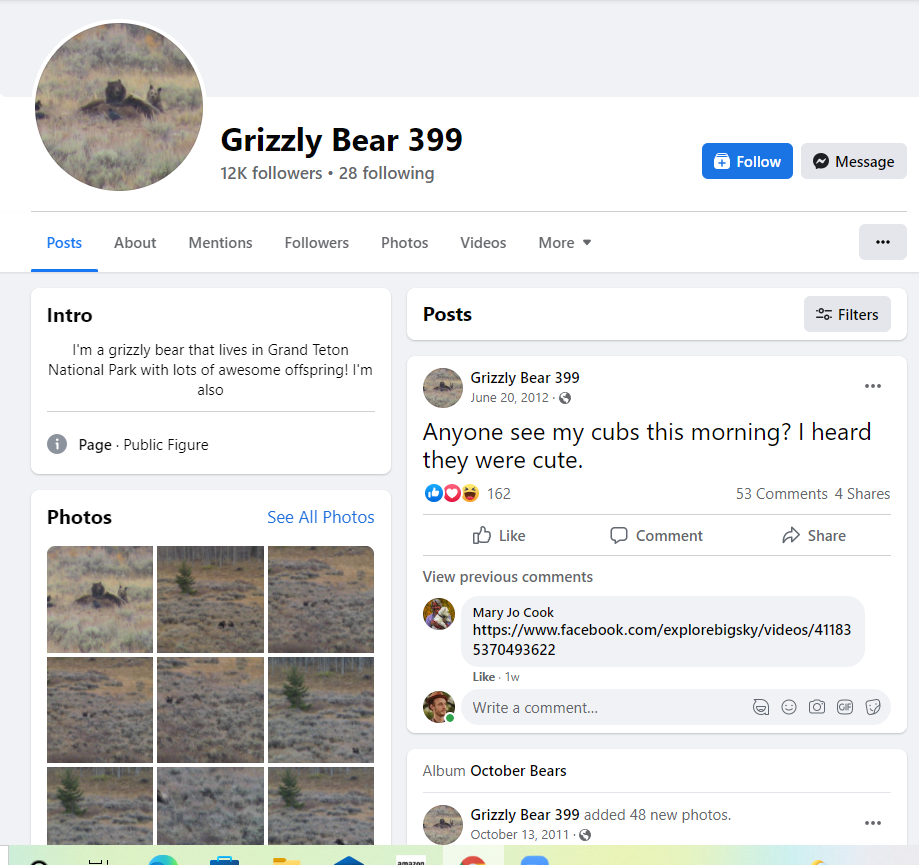
This experience was of a habituated bear. Habituated bears are those that have learned to ignore humans and go on with their lives. They are not afraid of humans, and unlike food-conditioned bears, they don’t seek out human food. Habituation has some advantages for bears, so wildlife managers in Grand Teton now tolerate bear habituation. Habituated bears don’t waste energy running away from people who are not a threat. They are also able to take advantage of habitat that is close to human roads and towns. Viewing habituated bears has become very popular. When I saw the bear alongside the road, I was part of what is called a “bear jam”--a traffic jam caused by people viewing a bear. Some bears have even become celebrities, especially grizzly #399, a habituated female who lives near Grand Teton. Over the years, grizzly #399 has raised several litters of cubs in roadside habitats. The four cubs in her most recent litter are almost four-years-old and ready to go off on their own as adults. She even has a Facebook page, proving that she is the ultimate habituated bear.
As bears and humans come into closer contact around Grand Teton, they need to interact in a way that is safe for both sides. Habituation is a safer response to human proximity than food-conditioning. Those of us who wish to enjoy Grand Teton National Park need to be responsible in the way we store and dispose of food. When we view a habituated bear, we need to obey the directions of park rangers and remember that we are still looking at a wild animal. That way, we can enjoy these majestic creatures without posing a danger to them or to us.